Mayan Temple Archaeoastronomy
 Editorial
- 19 Jul, 2026
The Foundations of Maya Archaeoastronomy
The Maya developed one of the most advanced astronomical systems of the ancient world, meticulously recorded in surviving bark-paper codices like the Dresden Codex. Within its pages lie elaborate Venus tables, eclipse warning tables, and Mars cycles—evidence of a patient, centuries-long observation campaign. Yet their greatest legacy is not ink but stone: the Maya physically encoded this knowledge into the orientation and design of their temples. Unlike modern observatories with movable domes, Maya architects used the natural horizon as a vast cosmic vernier, aligning structures to mark critical solar and planetary events such as solstices, equinoxes, and the heliacal risings of bright stars.
Archaeoastronomers today measure the azimuth and altitude of these ancient sightlines, compare construction dates with retro-calculated ephemerides, and interpret the rich iconography carved into stelae and friezes. This rigorous methodology has demonstrated that Maya ceremonial centers were rarely placed at random. Instead, their orientation often expressed a worldview where the sky was a map of divine order, and earthly architecture mirrored that celestial geometry. A ruler’s power, for instance, could be strengthened by aligning a temple’s dedication to the first morning appearance of Venus, the planet of war and kingship. The interplay between observation, mathematical calculation, and monumental construction reveals a society where astronomer-priests held immense influence.
The Dresden Codex itself offers a glimpse of this intellectual achievement. Its Venus table tracks the planet’s 584-day synodic cycle with an accuracy that rivals modern values, correcting for the slight difference between the canonical Maya period and true astronomical motion. Eclipse tables chart the intervals where lunar and solar eclipses were possible, using a base of 405 lunations (almost 33 years). Such data was not purely theoretical—it was immediately applied to the layout of cities. The famous E-Group architectural complexes, found across the Maya lowlands beginning in the Preclassic period, consist of a western pyramid facing a long platform with three structures to the east, designed so that the sun rises directly behind the central marker on equinoxes and behind the outer markers on solstices. These structures were essentially horizon calendars, and they set a template for centuries of astronomical architecture.
El Castillo and the Equinox Serpent
No example of Maya archaeoastronomy is more iconic than the pyramid of Kukulcán at Chichén Itzá, known as El Castillo. Every spring and autumn equinox, the setting sun casts a play of light and shadow on the northern balustrade, creating a rippling series of triangular shadows that glide downward to join the carved stone serpent head at the base. This phenomenon, drawing tens of thousands of modern visitors, is not a chance effect but a deliberate Postclassic design. The pyramid’s orientation is rotated approximately 17 degrees east of true north, a deviation that precisely illuminates the stairway’s risers on those specific dates, forming seven undulating triangles that evoke the feathered serpent’s scales.
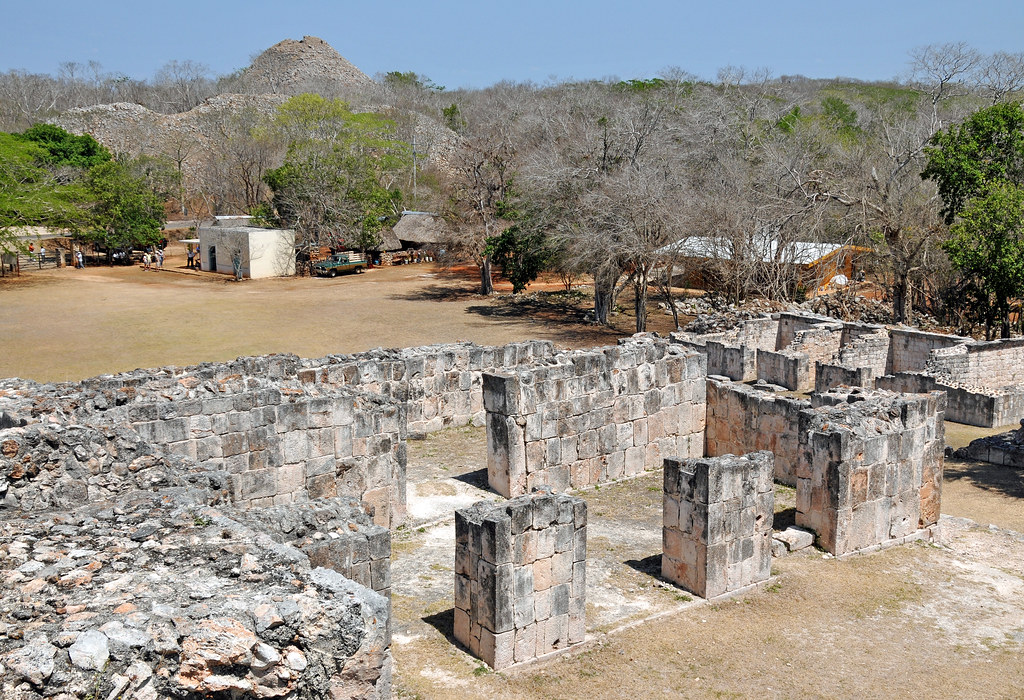
Beyond the visual spectacle, the pyramid’s dimensions encode deep calendrical meaning. The four stairways total 365 steps—one for each day of the solar year—while the 52 panels on each side of the nine-tiered structure correspond to the 52-year Calendar Round cycle that synchronizes the 260-day ritu-day vague year. Even the nine levels can be linked to the layers of the Maya underworld, Xibalba, and the number of Lords of the Night. El Castillo thus functions simultaneously as a timekeeping device, a mythological tableau, and a stage for public ritual that reaffirmed the ruler’s connection to Kukulcán, the feathered serpent deity associated with Venus and wind.
Recent laser scanning and photogrammetric studies have added another layer. The pyramid’s sloping sides are aligned to mark the zenith passage of the sun, the two days each year when the noon sun stands directly overhead—critical cues for planting maize across the Yucatán Peninsula. And remarkably, the interior older pyramid, accessible via a tunnel, shares the same orientation, proving that this solar alignment was maintained across multiple construction phases. The convergence of astronomical precision, calendar arithmetic, and sacred narrative makes El Castillo a supreme example of how the Maya united sky and stone. Much like how excavations at Karnak have revealed that Egyptian temples were oriented to capture specific solar and stellar phenomena, Maya architecture at Chichén Itzá demonstrates a parallel cosmic consciousness, though expressed through the serpent deity of Mesoamerica.
Uxmal and the Dance of Venus
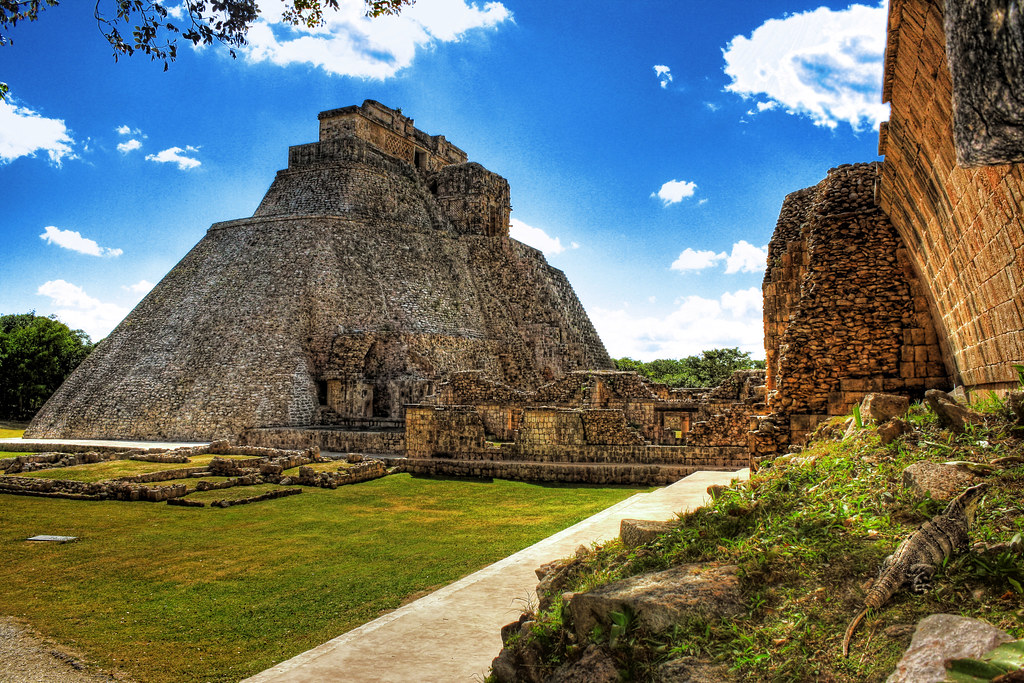
The Puuc-region city of Uxmal offers a different but equally profound example of planetary alignment. The Pyramid of the Magician, with its unusual elliptical footprint and steep stairway, has been shown to face the extreme northerly setting point of Venus on the western horizon. Venus, for the Maya, was a fearsome celestial entity—the morning star was associated with Quetzalcoatl/Kukulcán and warfare, often triggering the timing of raids and the accession of kings. At Uxmal, the temple atop the pyramid is positioned so that during Venus’s major standstill, the planet would appear to sink directly into the doorway from the viewpoint of the main plaza.
Complementing this is the Nunnery Quadrangle, whose long buildings are aligned with other Venus-related events. Archaeoastronomer Anthony Aveni measured the sightlines and found that the central arch of the complex frames the planet’s setting at key moments in its synodic cycle. The friezes adorning these structures are crowded with Venus symbols, chacs (rain gods), and serpents, reinforcing the marriage of celestial timing and religious art. Uxmal’s builders clearly used the landscape as a canvas, choosing a site where the natural horizon provided reliable markers for the planet’s wanderings, then erecting platforms and doorways to formalize those observations.
This obsession with Venus was not limited to Uxmal. The Caracol at Chichén Itzá, a round tower perched on a square platform, acts as a true observatory. Its narrow window slots are oriented to view Venus at its northern and southern extremes, as well as the setting sun on the equinox. The tower’s spiral staircase gives it its name (“Snail”), but the structure’s scientific function is unmistakable. Such buildings underscore that Maya astronomer-priests were not passive skywatchers; they actively designed spaces to freeze a particular moment of celestial geometry, allowing them to anticipate and ritually harness that energy year after year.
Astronomical Alignments at Palenque and Tikal
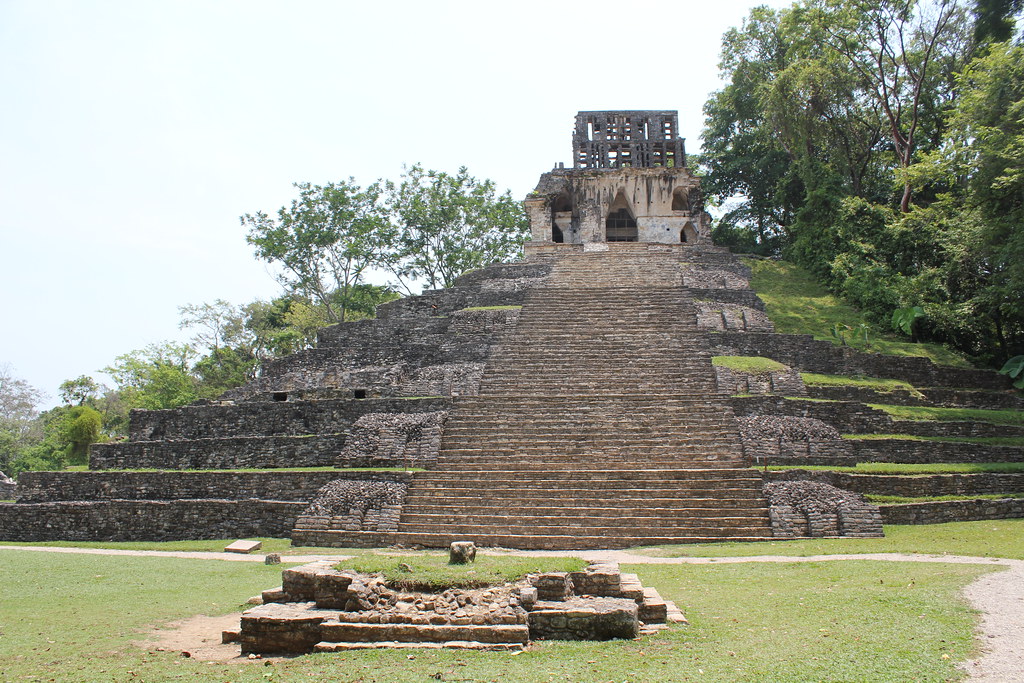
Palenque, nestled in the Chiapas highlands, is renowned for its exquisite stucco art and the Temple of the Inscriptions, burial place of the great ruler K’inich Janaab’ Pakal. Less known is that the temple’s central axis aligns with the setting sun on the day of the zenith passage, which here occurs on May 1 and August 12. At that moment, sunlight streams through a window into the inner chamber, illuminating the sarcophagus lid—a design that symbolically linked Pakal’s death and anticipated resurrection with the sun’s journey into the underworld. The nearby Temple of the Sun, part of the Cross Group, is oriented to observe the winter solstice sunrise, with light entering portals dedicated to the patron gods of the royal dynasty.
Tikal, the colossal city in Guatemala’s Petén jungle, further demonstrates the integration of astronomy and urban planning. The Mundo Perdido complex, a massive Preclassic pyramid, faces eastward toward three small temples on a platform, forming a classic E-Group. Sunrises on the solstices and equinoxes align precisely with these markers, allowing priests to calibrate the agricultural calendar. Temple IV, the tallest structure in the Maya world, is aligned so that at the winter solstice sunset, the sun descends directly behind Temple III as seen from the main plaza—a dramatic visual event that tied the iconic skyline to the solar cycle. At both cities, these alignments were not isolated quirks but part of a coherent system of sacred geography, where each temple played a role in mapping the movement of celestial bodies onto the earth.
The Maya Calendar and the Cosmic Order
To understand why the Maya invested so heavily in temple astronomy, one must grasp their concept of time. For the Maya, time was not an abstract progression but a sacred, cyclical unfolding of divine energies. The Calendar Round, combining the 260-day sacred almanac (Tzolk’in) with the 365-day vague year (Haab’), created a 52-year period after which a New Fire ceremony symbolically reset the world. Longer cycles were tracked via the Long Count, a vigesimal system that could pinpoint dates across hundreds of thousands of years. All of this required an intimate knowledge of the actual celestial motions, because the rituals meant to propitiate the gods had to occur on the day that matched the god’s cosmic manifestation.
Temple orientations often encode specific calendar dates. For example, at Copán, the famous Hieroglyphic Stairway and its associated temples have sightlines that mark the setting sun on the Maya date 4 Ahau 8 Cumku, a mythological creation event. By aligning architecture with such dates, rulers placed themselves within the grand narrative of cosmic time, presenting their reigns as reenactments of the acts of the gods. The east-west axis of many ballcourts, too, may symbolize the path of the sun and the mythological journey of the Hero Twins in the Popol Vuh, linking ritual sport with celestial movement. The ballcourt at Copán, for instance, is aligned to the equinox sunset, and the play likely represented the struggle between day and night, life and death.
This obsession with order extended to predicting eclipses. The Maya recognized the nodes of the lunar orbit and created warning tables in the codices to alert when a solar or lunar eclipse might occur. Although they could not predict eclipses with the absolute precision of modern astronomy, the tables gave high-probability windows, which were surely used to schedule ceremonies or perhaps to stage the ruler’s triumph over darkness. In the monumental record, eclipse glyphs appear on stelae and in texts commemorating key historical events, reinforcing the notion that the king’s authority was bound to his ability to “control” the forces of the sky.
Zenith Passage, Agriculture, and Architecture
One uniquely Maya concern was the zenith passage of the sun—the two days per year when the sun crosses the local latitude directly overhead. Because the Maya homeland lies between the tropics, this event occurs at every site, but the dates vary with latitude. The zenith passage marks a critical moment for the agricultural cycle: typically, the first passage in spring heralds the onset of the rainy season and the time to plant maize, while the second passage in summer coincides with the peak of the growing season. For a society utterly dependent on maize, correctly timing the zenith was a matter of survival.
Architecturally, the Maya created “zenith tubes” and vertical openings to detect this phenomenon. At Xochicalco in central Mexico (a site with strong Maya influence), a vertical shaft in an underground observatory allows a beam of sunlight to project onto a marked floor only on the zenith days. Similarly, at Monte Albán, the Zapotec predecessors of the Maya zone built a structure that tracked the zenith. Among the Maya themselves, many temples contain internal chambers where a beam of light penetrates at the zenith, illuminating a stela or altar. At Sayil, in the Puuc region, a small opening in an upper room projects a solar image onto a stucco floor marker precisely at noon on the zenith date, confirming that this knowledge was widespread and physically encoded.
Additionally, the Maya observed the “nadir” passage—the sun’s position on the opposite side of the Earth—which occurs six months after the zenith and was equally important for ceremonies. Temples were sometimes aligned to capture the first rays of the sunrise or last rays of sunset on these dates, doubling the calibrating power of a single structure. By tying monumental construction so tightly to the sun’s vertical movement, the Maya anchored their entire agricultural rhythm and ceremonial calendar in visible, public architecture that could be read by anyone, from priest to farmer.
Stars, Milky Way, and the Cosmic Monster
Beyond the planetary focus, the Maya also oriented temples to bright stars and the Milky Way. The constellation we call Orion, for them was a celestial hearth, the three stars of its belt corresponding to the three hearthstones of creation. At many sites, triadic pyramid groups represent this cosmic hearth on the ground. The Milky Way itself was seen as the World Tree (Wakah Chan) or a cosmic serpent, linking the underworld, the earthly realm, and the heavens. Its changing orientation through the night and year likely influenced the layout of ceremonial axes.
At Chichén Itzá, the Caracol’s windows not only tracked Venus but also the setting of the Pleiades and other stars used for seasonal markers. The Pleiades, with their predawn rising, signaled the beginning of the rainy season and were linked to the death and rebirth of deities. In the codices, star glyphs appear alongside moon and eclipse signifiers, indicating a comprehensive celestial mapping. The Maya also observed the helical rising of Sirius, though it did not dominate their calendar as in Egypt. Yet the very act of embedding star alignments into temples suggests that rulers saw these lights as ancestral spirits or divine powers whose cyclical return ensured agricultural fertility.
Even the design of roadways, or sacbeob, sometimes respected astronomical lines. The long sacbe at Coba, for instance, points toward the sunrise on the zenith passage date. Such landscape-scale alignments confirm that archaeoastronomy for the Maya was not an afterthought but a primary planning principle, knitting together urban center, suburban settlement, and forest horizon into a single calendar.
Preserving and Interpreting the Mayan Sky Legacy
Today, archaeoastronomy continues to refine our understanding of Maya temples. Technologies like LiDAR (Light Detection and Ranging) are penetrating dense jungle canopy to reveal previously unknown structures and their alignments on a regional scale, showing that entire cities were laid out according to celestial templates. This new data is overturning old assumptions: what seemed like random orientations now emerge as part of a unified cosmological plan that could span dozens of kilometers. Even modest residential platforms sometimes share the same orientation as major temples, suggesting that sky knowledge permeated all levels of society.
The preservation of these alignments is fragile. Urban development, climate change, and even well-meaning restorations can subtly alter the sightlines that took millennia to establish. Archaeoastronomers work alongside archaeologists and indigenous Maya communities, whose living traditions still retain agricultural and ritual practices tied to the sun and stars, to protect both the physical sites and intangible heritage. The serpiente de luz at Chichén Itzá may be the most famous, but thousands of other light-and-shadow effects, waiting to be rediscovered and documented, remain scattered throughout the Maya world.
In the end, Maya temple archaeoastronomy teaches us that these pyramids are more than monuments—they are dialogues in stone, a permanently open book of the sky. Every equinox sunrise that floods a temple doorway, every Venus setting that slips through a well-placed notch, echoes the voices of astronomer-priests who counted, observed, and built. As research continues, we will undoubtedly uncover even deeper layers of meaning in this extraordinary synthesis of science, religion, and art, securing the Maya legacy as one of humanity’s most accomplished skywatching civilizations.